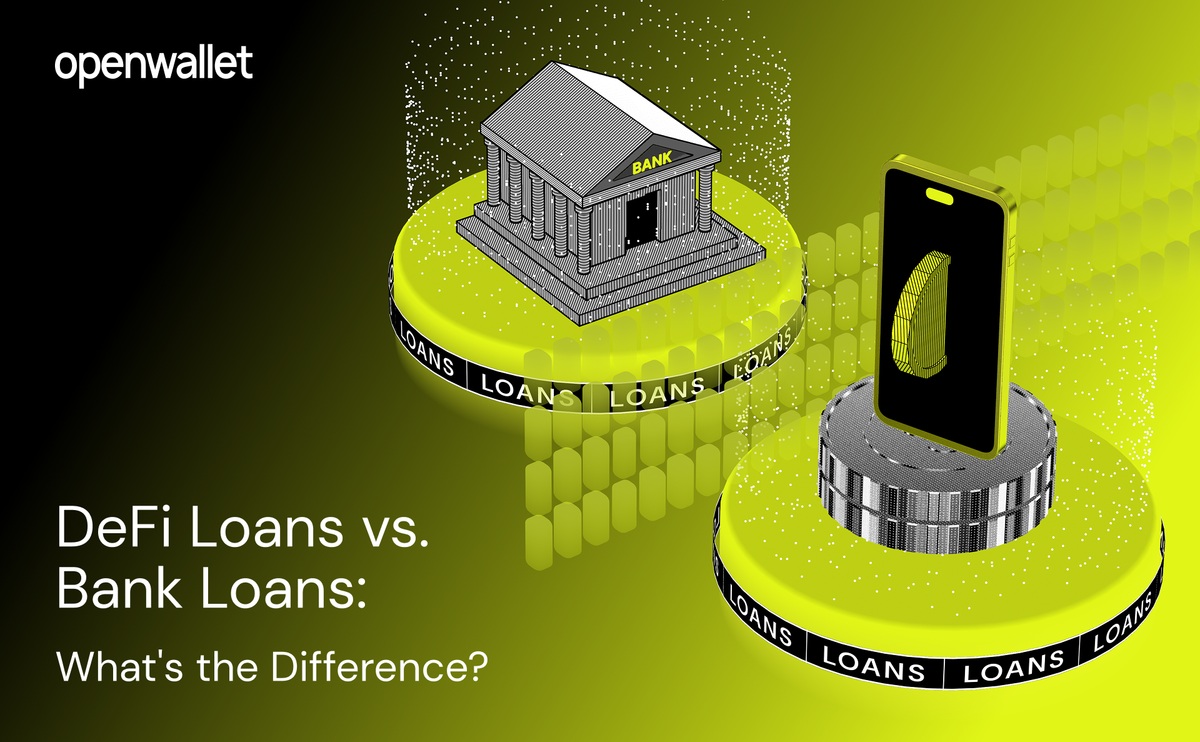
DeFi Loans vs. Bank Loans: What's the Difference?
Most people have taken out a loan before. A car loan, a personal loan, maybe a mortgage. You know how it works: you fill in forms, the bank checks your credit score, and a few days (or weeks) later, you either get approved or you don't.
DeFi loans work completely differently. And depending on your situation, they can do things a traditional bank loan simply can't.
Here's a breakdown of how both loans work.
How a Bank Loan Works
When you walk into a bank and ask for a loan, the bank is asking one question: can we trust that you'll pay this back?
To answer that, they look at the following:
- Your credit score
- Your income
- Your employment
- Your jurisdiction
If you tick all those boxes, you get approved. For reasons like no local income, bad credit history, or just bad timing, you will not get approval.
The loan itself is unsecured or partially secured depending on what you're borrowing for. A personal loan is often unsecured, meaning the bank is purely trusting your creditworthiness. A mortgage is secured against the property itself.
Interest rates depend on the type of loan, bank, your profile, and the market.
How a DeFi Loan Works
A DeFi loan skips all of that.
Instead of trusting your credit history, it trusts your collateral.
Here's the core idea: you lock up crypto you already own (say, Bitcoin or ETH) as collateral. In return, the protocol lends you stablecoins.
The key mechanic is called the loan-to-value (LTV) ratio.
If you have $10,000 worth of Bitcoin and the protocol offers a 75% LTV, you can borrow up to $7,500. The remaining 25% acts as a buffer to protect the protocol if your collateral drops in value.
Everything is enforced by smart contracts. There's no loan officer making a judgment call. The rules are written into code and they execute without exceptions.
Comparison Chart Between Bank and DeFi Loans
| Bank Loan | DeFi Loan | |
|---|---|---|
| Approval process | Credit check, income proof, documents | Just collateral |
| Time to receive funds | Days to weeks | Less than a minute |
| Who can apply | Residents with credit history | Anyone with crypto |
| Collateral required | Sometimes (mortgage, car loan) | Always |
| Interest rate | Fixed, set by the bank | Variable, set by the market |
| What happens if you don't repay | Legal consequences, credit damage | Your collateral gets liquidated |
| Available hours | Business hours | 24/7, always on |
| Geography | Usually country-specific | Borderless |
What "Liquidation" Means
This is the part that confuses most beginners, and it's worth understanding clearly before you take out a DeFi loan.
When you borrow against your crypto, you're locking it up as collateral. If the value of that collateral drops significantly (e.g., Bitcoin falls 40%), your loan-to-value ratio starts creeping too high.
If your collateral falls below the safe threshold, the protocol automatically liquidates a portion of it to repay the loan. This happens programmatically.
This is very different from a bank loan. If you miss mortgage payments, there's a lengthy legal process before anything happens. With a DeFi loan, liquidation can happen almost instantly.
The way to protect yourself is simple: don't borrow close to your maximum LTV. If the protocol allows 75% LTV, borrow 50% instead. That gives you a much larger buffer before your collateral is at risk.
Why Would Anyone Borrow Against Their Crypto?
This is the most common question.
Imagine you bought Bitcoin at $40,000, and it's now worth $60,000. You need extra cash for something like a business expense, a property down payment, an emergency, or to buy even more crypto.
What are your options?
Option A: Sell your Bitcoin. You get the cash, but you lose your position. If Bitcoin goes to $100,000 next year, you will have missed it. And depending on where you live, selling is a taxable event.
Option B: Take out a DeFi loan. You lock up your Bitcoin as collateral, borrow $15,000–20,000 in USDC, and use it for what you need. Your Bitcoin stays in your name. If it keeps appreciating, you benefit. When you want to close the loan, you repay the USDC and get your Bitcoin back.
You've accessed your wealth without selling it. That's the core value proposition.
Rahul's Property Down Payment
Rahul had been living outside India for 11 years. When he found a property in India, he ran into every wall traditional finance puts up for people in his situation:
- Indian banks wouldn't lend him money because he had no local salary
- European banks wouldn't finance property in India
- Personal loans were available at 15–17% interest
- Most of his net worth is in Bitcoin which were neither easily convertible for an Indian property purchase
Here's what he did instead, using Open Wallet:
- Rahul opened a loan at 75% LTV against his WBTC and received USDC instantly
- Sent that USDC directly to his Indian bank account via Open Wallet's off-ramp, which landed as INR in under 90 seconds
Total time: under 10 minutes.
His Bitcoin exposure stayed intact, and the loan gave him the liquidity he needed without selling anything. Also, throughout the process, there were no banks, loan officers, or lengthy approval processes.
This is a flow that traditional finance will never be able to replicate.
Which One Is Right for You?
A bank loan makes sense if you need to borrow without putting up collateral, you don't hold crypto, or you want a fixed, predictable repayment structure.
A DeFi loan makes sense if you already hold crypto and don't want to sell it; you need fast access to liquidity; you're in a situation where traditional banks can't or won't help (different jurisdiction, no local income, etc.); or you want to access funds at any time without approval delays.
They're not competing products.
Banks and DeFi serve different situations. But for anyone who holds meaningful crypto and needs liquidity, a DeFi loan is a tool that solves problems traditional finance cannot solve.
Ready to borrow against your crypto without selling it? Download Open Wallet and explore the Borrow feature powered by Morpho.