What Are Prediction Markets? How Event Outcomes Become Tradeable Tokens
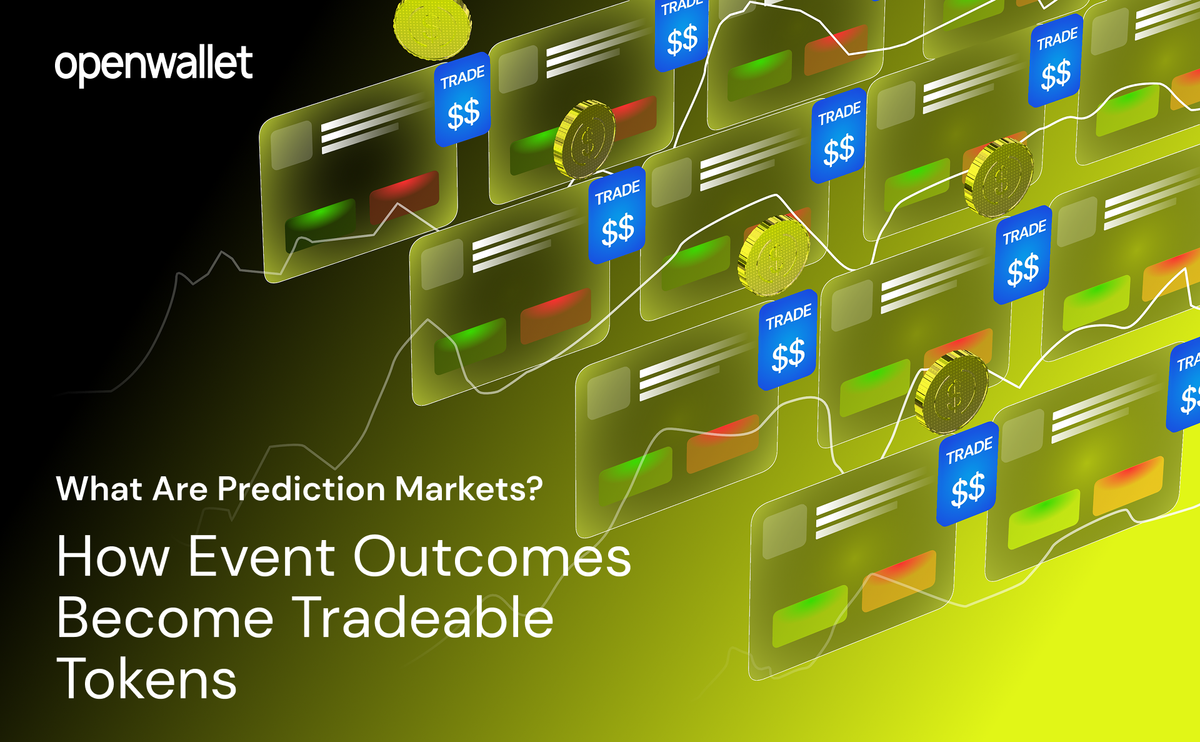
Prediction markets are everywhere right now.
Kalshi is valued in the billions. Polymarket processed hundreds of millions in volume during the last US election cycle. CNN and CNBC are embedding market odds alongside headlines. The Economist called it "betting on democracy."
Most of the conversation orbits one question: Isn't this just another form of sportsbook?
In this article let’s explore what prediction markets can do that nothing else could before.
The Outcomes Are 1:1 backed.
This sounds obvious until you think about it.
In traditional gaming (sportsbooks and casinos), the house holds your money and promises to pay you out. That model works fine until it doesn't. When a platform runs short on liquidity, winners get paid in installments.
Some don't get paid at all.
Tokenized prediction markets like Kalshi work differently.
When you buy a "Yes" or "No" outcome token, those tokens are backed 1:1 in escrow. If you hold 500 "Yes" tokens worth $500, that $500 is already locked. There's no counterparty risk. The payout doesn't depend on whether the platform had a good month.
This is a genuinely structural difference between traditional games.
You Can Exit Before The Event Ends
Traditional sports betting has long offered cash-out features. So the ability to exit mid-event isn't entirely new.
What prediction markets do differently is change the mechanism underneath that exit.
Because your outcome is tokenized as a real on-chain asset, you're not asking a bookmaker for permission to cash out at their quoted price. You're selling into an open order book, where price is determined by what other participants are actually willing to pay in real time.
If you bought "Yes" on an election outcome at 40 cents and it moves to 70 cents, you can sell your position at market price with no operator intermediary and no proprietary cash-out formula.
This is why Kalshi's founder describes their platform as an order book, not a sportsbook. The mechanics are structurally closer to options markets than to a parlay.
That distinction matters because it changes who can participate meaningfully. You don't just need to be right about an outcome; you need to be right before the crowd moves. It rewards research, pattern recognition, and timing, not just luck.
Outcome Tokens Can Live in Your Wallet Like Any Other Asset
Here's where it gets genuinely interesting.
Once an outcome is tokenized, it inherits the full programmability of crypto. That opens up things that aren't possible in any traditional format:
- Borrow against your position. Hold 1,000 "Yes" tokens on a market you're confident about. In the future, you'll be able to use those as collateral and borrow against them like pledging stock as collateral for a loan.
- Earn yield while you wait. Stake your outcome tokens in a vault and earn interest while the market resolves itself. Dead capital becomes working capital.
- Spend your winnings directly. When the market resolves, instead of cashing out to fiat and back to crypto, you could claim USDC and spend via your wallet's debit card or off-ramp. The whole cycle becomes one step.
None of these are hypothetical. They're natural extensions of what's already possible when you put financial instruments on-chain.
Prediction Markets Is A Real-Time Layer For Information
Something subtler is happening at the media level.
Prediction markets are increasingly being embedded into news coverage as a signal. When CNN shows a Polymarket probability alongside an election headline, they're treating market pricing as a form of consensus. Editors are starting to trust it the way they trust polling data, sometimes more.
This is "InfoFi" in practice: information that has been financially validated. When thousands of people put real money behind a probability, the number carries different weight than a survey does. It doesn't mean it's always right, though. Markets can be wrong, and they can be manipulated. But as a real-time aggregation of informed opinion, it's a new kind of signal that didn't exist five years ago.
Prediction markets are becoming infrastructure for how the world prices uncertainty.
What We're Building Toward
We received Kalshi’s API access a few months ago. Within the next two months, we plan to bring prediction markets into Open Wallet, built for users who already understand why on-chain finance matters.
With Open Wallet, you can hold tokenized assets in your self-custody wallet.
When the market resolves, your payout can be held to earn yield, off-ramped to your bank account, or transferred to anyone, all without leaving the app.
Prediction markets aren't a detour from what crypto does best. When built right, they're a direct expression of it.
Open Wallet integrates Kalshi prediction markets and will be launching soon. Download Open Wallet to get early access when it goes live.