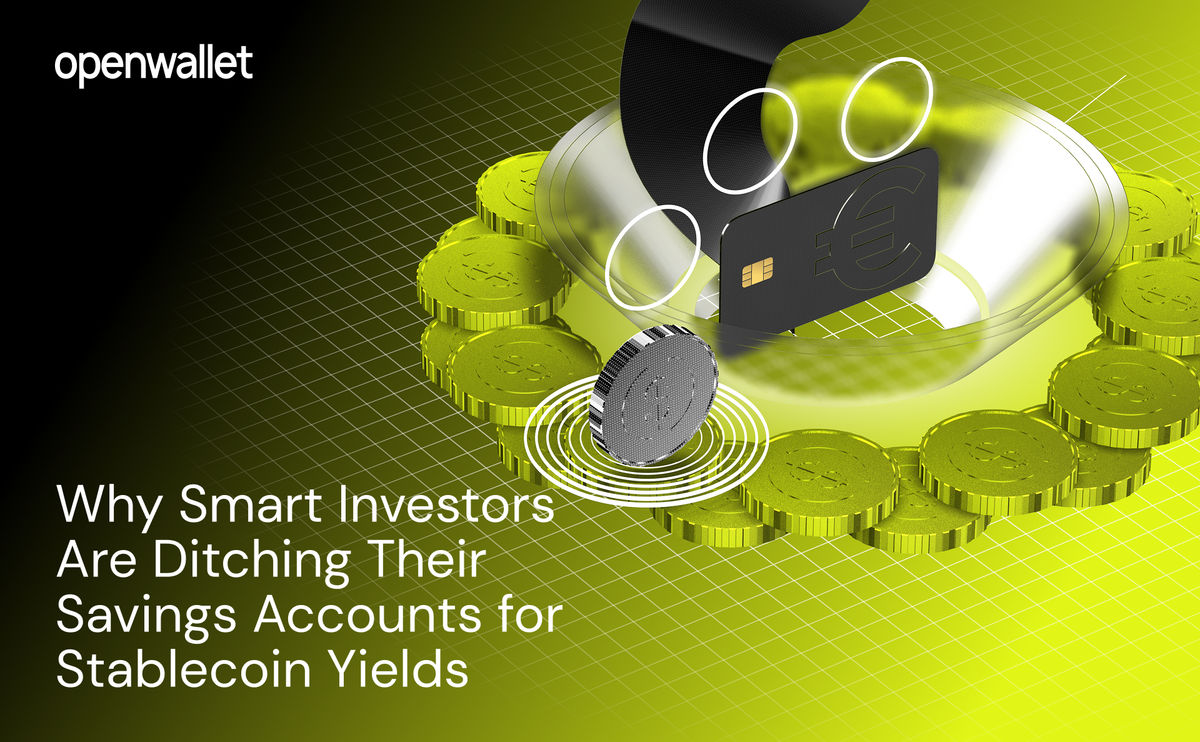
Why Smart Investors Are Ditching Their Savings Accounts for Stablecoin Yields
Let's be honest about what a savings account does for you in 2026.
In most developed markets, legacy banks are offering between 0% and 2% annual interest. Meanwhile, inflation has been running persistently higher which erodes your purchasing power month after month.
What if there were a way to earn 5–7% annually on dollar-pegged assets, with no lock-up, no broker, and full transparency over where your money goes?
That's exactly what a new class of investors has discovered and it doesn't involve speculating on any crypto, not even Bitcoin.
"Stablecoin Farms" As The New Savings Model
"Stablecoin farms" is a term used to describe strategies that put idle stablecoins to work earning yield through crypto lending markets rather than traditional banks.
The mechanism is straightforward.
People who hold large amounts of Bitcoin or Ethereum often want access to dollar liquidity without actually selling their holdings (selling triggers taxable events, and they believe their assets will appreciate). So they borrow stablecoins by putting up their crypto as collateral, and they pay interest on the loan.
That interest flows to the lender, which could be you.
Is this dangerous?
Nope. Borrowers are over-collateralized. To borrow $10,000 in USDC, a borrower might need to lock up $15,000 worth of Bitcoin as collateral. Smart contracts enforce this automatically and liquidate collateral if Bitcoin drops too far in value. There's no loan officer, no credit check, and no trust required as the smart contract handles everything.
This isn't a Ponzi scheme.
The yield comes from real economic activity: traders paying for leverage, market makers accessing liquidity, and arbitrageurs capitalizing on price differences across exchanges. It's the same fundamental principle as a collateralized bank loan but without the bank extracting most of the margin.
That being said, there are cases where protocols are over-leveraged and lose customer funds.
How Stablecoin Farming Has Evolved Over The Years
To understand where stablecoin farming is today, it helps to understand how it got here. The journey has three distinct chapters.
Chapter 1: The Protocol That Proved It Was Possible
Aave launched the first mainstream decentralized lending protocol.
For the first time, anyone with an internet connection could deposit stablecoins into a smart contract and earn interest. Aave demonstrated that on-chain lending is one of the most important financial primitives.
Today, Aave has processed hundreds of billions of dollars in loans.
It's been audited exhaustively, battle-tested across multiple market cycles, and has become the foundational infrastructure underpinning much of the DeFi lending ecosystem. When institutional players started taking DeFi seriously, Aave was usually the first name they encountered.
But Aave's success also sparked an explosion of copycats.
Dozens of protocols launched, each claiming to offer slightly higher yields through different strategies: different collateral types, different risk parameters, and different liquidity incentive schemes. For early adopters, this was exciting.
For everyone else, it was completely overwhelming.
Chapter 2: Protocol Fatigue
By the early 2020s, there were hundreds of lending protocols competing for your stablecoin deposits. Each offered different rates, carried different risks, and required you to do a ton of research to optimize for the best portfolio.
Chasing yield across protocols suddenly became a full-time job.
In fact, sophisticated "yield farmers" would move capital between protocols weekly to optimize returns. The complexity also created real risk. Protocols that chased higher yields sometimes cut corners on security or accepted riskier forms of collateral.
Several high-profile exploits resulted in users losing funds. The promise of higher returns was real, but so was the danger of navigating the space alone without deep technical expertise.
The industry needed a layer of abstraction. Something that could manage this complexity on behalf of regular users, the way a fund manager handles a portfolio so you don't have to pick individual stocks.
Chapter 3: Curated Vaults for the Masses
Morpho solved the protocol fatigue problem by introducing the concept of curated vaults.
Rather than asking individual users to research and select lending markets, Morpho allows professional "curators," aka reputable risk management firms with expertise, to design and manage vaults with specific parameters.
When you deposit into a Morpho vault, you're not choosing between 50 protocols. You're delegating that decision to experts who have already done the analysis: which collateral types to accept, what loan-to-value ratios are safe, and how to diversify across markets to optimize risk-adjusted returns.
The vault rebalances automatically, and you watch your balance grow.
Morpho's credibility is substantial.
It now powers the yield rates offered inside Coinbase's own products. This means millions of mainstream users are already accessing Morpho-backed yields without even knowing the name.
Institutional asset managers like Bitwise have launched stablecoin vaults explicitly built on Morpho infrastructure, marketing them to institutional clients as "digital fixed income." This is a direct comparison to the bond market.
The era of stablecoin yield as a legitimate asset class had arrived.
Chapter 4: Being Able To Earn And Spend Stablecoins In One App
Even with Morpho's abstraction layer, one problem remained: the on/off ramp.
Earning 6% on your USDC is great! But if converting that yield back to spendable money requires navigating crypto exchanges, withdrawal limits, and bank delays, most people won't bother. The friction at the edges of the system was keeping mainstream users away.
This is the gap Open Wallet is designed to close.
Open Wallet directly integrates Morpho vaults into a non-custodial mobile wallet. This means you own your own funds with no intermediary holding your money. Depositing into a yield-generating vault takes seconds.
But the real breakthrough is on the spending side: Open Wallet gives you two ways to spend what you earn.
First, you can off-ramp your yield directly to your bank account in USD, GBP, EUR, or a growing list of local currencies in under 90 seconds. Your 6% returns don't stay locked in crypto.
You are able to spend your yield exactly like how you would with a bank account.
Second, you can simply spend your yield with a debit card, paying for everyday transactions directly from your stablecoin balance. Your morning coffee, your groceries, and your online subscriptions are all funded by the yield from your savings.
This is the full stack, finally assembled.
- Aave's foundational lending rails
- Morpho's risk-curated vaults
- Open Wallet's seamless real-world spending interface.
For the first time, earning yield on stablecoins and spending it like cash are part of the same experience.
Who Should Be Paying Attention?
The stablecoin yield strategy is worth considering if you
- Hold cash savings in USD, EUR, or GBP and want a better return than your bank offers
- Are comfortable with digital tools and apps but don't want to learn how to trade crypto
- Want yield that's transparent and verifiable
- Want access to your money without lock-up periods or advance notice withdrawal requirements
- Are frustrated that inflation is steadily outpacing what your savings account returns
It's worth being honest about the caveats.
Smart contract risk is real, and protocols can have bugs. Rates are variable, not fixed, meaning they fluctuate with borrowing demand across the market. And while Morpho's curators and Aave's track record provide meaningful risk mitigation, no financial instrument is entirely without risk.
But compare that risk profile to what you're already accepting: a savings account at a bank that earns near-zero interest while inflation quietly erodes your purchasing power for years.
Download Open Wallet
Open Wallet is a non-custodial crypto wallet integrating Morpho lending vaults, on/off-ramp banking, and a debit card, which enables users to earn institutional-grade stablecoin yields and spend them in everyday life.
Download Open Wallet here
This article is for informational purposes only and does not constitute financial advice. The content presented here reflects general market observations and should not be taken as a recommendation to buy, sell, or hold any financial instrument or digital asset. Always conduct your own research and consult a qualified financial advisor before making any investment decisions.